Back to Work
Concept Intelligence Platform
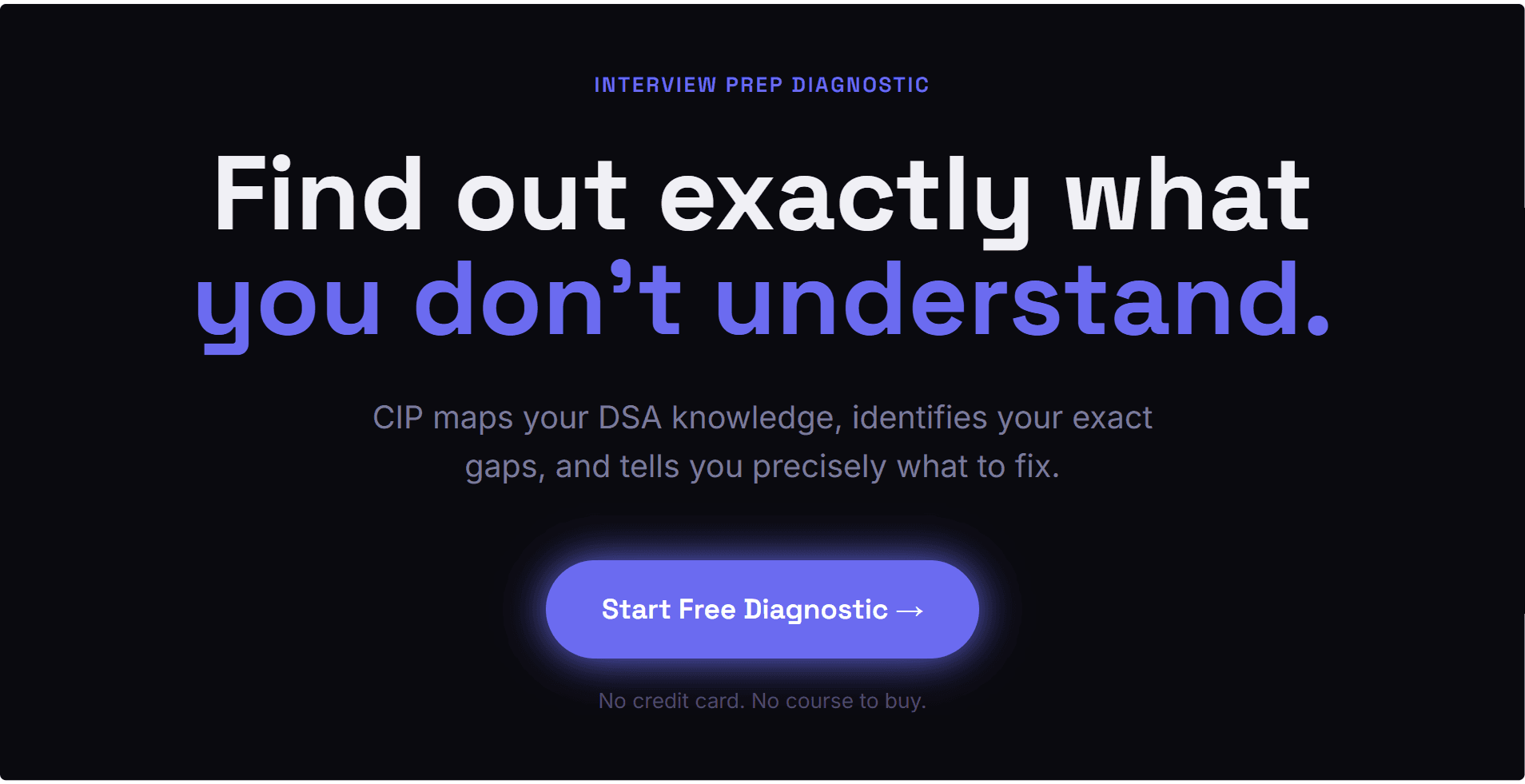
BuildingA diagnostic tool that finds the gaps in how you understand a DSA topic, not just whether you solved the problem.
- Next.js
- FastAPI
- PostgreSQL
- Supabase
- Gemini 1.5 Flash
- Python
The Problem
What It Does
Architecture & How It's Built
Decisions & Tradeoffs
- The hardest challenge hasn't been technical. It's been defining what understanding actually means in a way that's both rigorous enough to be useful and flexible enough to handle the way people actually learn. Should understanding a binary tree mean being able to implement insertion from memory? Or should it mean being able to explain why the recursive traversal uses O(h) space without being prompted? Or both? The answer depends on the context, and building a system that adapts its standards to the learner's goals without becoming inconsistent is the design problem I keep coming back to.
- The four-topic MVP scope is another uncertainty. Arrays and Hashing, Linked Lists, Binary Trees, and Graphs cover a reasonable spread of difficulty, but I picked them before testing whether the concept-graph-authoring effort scales linearly per topic or gets harder for messier prerequisite structures.
- I learned that most educational tools optimize for engagement metrics because those are easy to measure. Time spent, problems solved, streaks maintained. Understanding is hard to measure, so it gets proxied by completion. Building a tool that directly measures understanding means accepting that your metrics won't look as impressive as a gamified platform's, but they will be honest.
- I also learned that when you design for explainability first, every decision becomes harder but the result is more durable. Every time I was tempted to let an LLM do more work and call it a day, I had to stop and ask: can I trace why this system produced this output for this specific user? If the answer was no, I had to redesign.
Roadmap & What's Next
The next step is writing the first database migration and starting implementation of the Postgres schema and the expert concept graph for Arrays and Hashing. After that, the goal is to have a working prototype that I can test on actual learners, not synthetic cases.
Long term, if the diagnostic proves useful for DSA topics, I would extend it to system design concepts, where the gap between knowing definitions and being able to reason about tradeoffs is even wider.
Technology Stack
Next.js
FastAPI
PostgreSQL
Supabase
Gemini 1.5 Flash
Python
Quick Links
Started Last updated